Open houses are the number one selling tool because they concentrate buyer attention on your property, create a competitive atmosphere, generate real-time intelligence about who is in the market, and give a skilled agent the opportunity to have qualifying conversations with motivated buyers who have already self-selected your home as worth visiting. When run by a trained team, every visitor tells you something valuable about the market.
There is a debate in the real estate industry about whether open houses actually work. Some agents dismiss them. Some sellers avoid them. The data, and 12 years of experience, tells a different story.
Open houses work. But they only work when the agent running them has a system. And that is where most teams fall short.
The difference between a great open house and a wasted Sunday is not the property. It is the agent. It is whether the person standing in your living room on a Sunday afternoon knows how to read every visitor who walks through the door, ask the right questions, and turn what they learn into intelligence that serves you, the seller.
That is what the Michael Paul Real Estate Team is trained to do. And this is why we make open houses the number one priority in every listing we take on.
What Most People Get Wrong About Open Houses
Most people think open houses are about selling the home to the people who walk through on that specific day. That is not their primary function. Their primary function is to concentrate buyer attention, create competitive energy, and generate real-time intelligence about what the market thinks of your home. NAR data shows 37% of buyers visited the home they ultimately purchased at an open house, but most of those buyers did not buy on the day of the open house itself.
Here is the misconception that costs sellers money. They think an open house is a success if someone makes an offer that afternoon. And they think it is a failure if no one does.
That is the wrong scorecard entirely.
The open house serves a different function from what most people assume. It is the conversion event, the moment a buyer moves from interested to serious. Buyers find listings online first, then decide which ones are worth visiting in person. The open house is where that decision gets made.
Open houses generate roughly 30% of all real estate leads, and recent industry data shows 65% of open house attendees transact within three months. Open house leads convert at 45% higher rates than online leads when paired with a proper capture and follow-up system.
The visitors who walk through your door on a Sunday are not random. They are buyers who saw your listing online, found it interesting enough to leave their house, make the drive, and walk through in person. That is a self-selecting, motivated group. The question is not whether they are interested. The question is how interested, how ready, and what it will take to move them to an offer.
A trained agent can find out all of that in the first two minutes of conversation. Starting with one question.
"The open house is not where you sell the home. It is where you discover who wants to buy it, and why. That intelligence is gold for every seller."
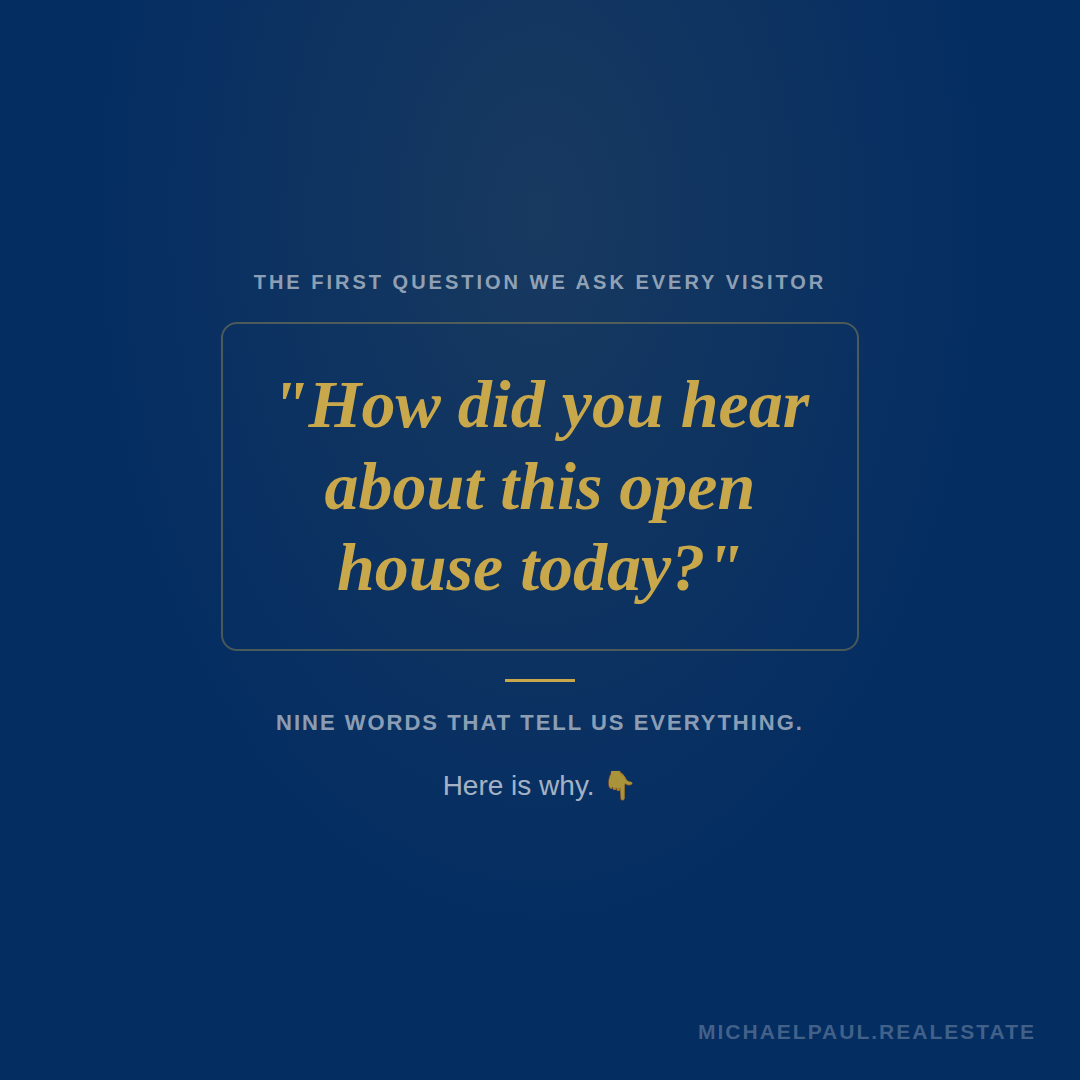
The Most Important Question We Ask Every Visitor
The moment a visitor walks through the door, after welcoming them warmly and handing them the feature sheet, every Michael Paul Real Estate Team agent asks the same question:
"How did you hear about this open house today?"
Nine words. But the answer to that question tells a trained agent almost everything they need to know about who is standing in front of them, what their motivation level is, and how to serve both the visitor and the seller most effectively.
Here is what the most common answers actually mean, and why each one requires a completely different conversation.
"We were just driving by and saw the sign."
This is the most common answer at any open house and the one that most agents misread. A trained agent does not dismiss this visitor as a nosy neighbour and move on. They ask the next question. Are they from the neighbourhood? Because if they are, they might be a neighbour who has family looking to move to the area, one of the most underrated lead sources in real estate. Are they driving through because they are already scoping out the street? Because if they are, they have already selected the neighbourhood and your home just became a candidate. Or are they genuinely just curious with no buying intent? A skilled agent finds out in the next thirty seconds with a simple follow-up: "Are you familiar with the area? Have you been looking at homes nearby?" The answer tells you everything.
"We saw it on Realtor.ca."
This is one of the strongest signals a seller can receive. Think about what this person did. They were browsing active listings. They clicked on your property. They looked at the photos. They liked what they saw enough to put it on their list. They checked the open house time. They made a deliberate trip on a weekend to see it in person. That is not casual interest. That is motivated buyer behaviour. This visitor came because something about your home spoke to them online, the price, the layout, the neighbourhood, the photos. The agent's job now is to find out exactly what attracted them, reinforce it, and build the bridge between their online impression and a real conversation about next steps. This visitor deserves the full conversation.
"I saw it on Instagram" or "I saw it on Facebook."
A social media buyer is digitally engaged and found your listing through targeted content, which means your marketing reached beyond the standard MLS audience. These buyers are often slightly earlier in their journey than a Realtor.ca visitor. They may not have narrowed down their neighbourhood yet, they may still be forming their criteria, and they are likely comparing multiple options. This is not a weakness, it is an opportunity. A buyer who has not yet committed to a neighbourhood is a buyer who can be guided. The agent's job is to understand what stage they are at, what matters to them, and whether this property fits what they are building toward. These conversations often generate the most valuable long-term relationships, buyers who are not ready today but will be in 60 or 90 days.
"Our agent sent us."
A visitor sent by their agent is one of the most qualified people who will walk through your door. Their agent has already assessed their budget, their timeline, and their criteria, and decided your listing was worth their client's time. That is a professional endorsement from another real estate professional. These buyers have usually been pre-approved. They know what they are looking for. They have their representation sorted. The agent's job here is not to sell them, it is to present the property honestly and professionally, answer every question thoroughly, and leave a strong impression that their agent will hear about when they debrief after the visit. Handled well, this conversation often leads to a showing request and a real offer conversation within days.
"We got an email about it" or "We saw it in a newsletter."
A buyer who came from a direct email or a personal referral is often among the most serious visitors at any open house. They are on an agent's active database, which means an agent has already qualified them, knows their criteria, and thought specifically of your listing when they saw it. Or they were referred by someone who knows their situation and thought your property was worth a look. Either way, this person came with context. They did not stumble across your listing by chance. Someone pointed them to it specifically. The agent's job is to understand the context, build on the warm introduction, and make sure this visitor leaves with a clear next step.
Why This Question Changes Everything
Most agents at open houses are focused on one thing: telling visitors about the home. The square footage. The kitchen renovation. The school catchment. The neighbourhood.
That information matters. But delivering it the same way to every visitor, regardless of who they are, what their motivation is, or what stage of buying they are at, is a missed opportunity of the highest order.
A trained agent listens first and talks second. Because a visitor who found the home on Realtor.ca and has been looking for six months needs a completely different conversation than a visitor who was just driving by and had never seen the street before.
And the seller deserves to know which one of those conversations happened, and what it means for their sale.
What a great open house debrief looks like for the seller: After every open house, the Michael Paul Real Estate Team provides a full report to the seller. How many visitors came. Where they heard about the property. What questions they asked. What they said about the price. What they said about competing properties. What the general market sentiment was. This is real intelligence that shapes pricing decisions, follow-up strategy, and the seller's understanding of where they stand in the market right now.
How Our Coaching-Led Team Is Different at Every Open House
The Michael Paul Real Estate Team is led by Michael Paul, a licensed real estate broker and trained real estate coach. Every agent on the team is coached in the art of qualifying conversations, a skill most agents in the GTHA have never been formally trained in. That means every visitor to a Michael Paul open house is met with a structured, professional conversation that generates intelligence for the seller, identifies serious buyers, and represents the listing with the level of professionalism every seller deserves.
The Coaching Difference at Every Open House
Before Michael Paul was a team leader, he was a Royal LePage broker manager for three years. His job was not selling homes, it was training agents to sell homes. Teaching conversation skills. Coaching agents on how to qualify a buyer in sixty seconds. How to read a room. How to ask the right follow-up question at exactly the right moment.
That coaching philosophy is embedded in every agent on the Michael Paul Real Estate Team. They are not just trained in the mechanics of real estate, the contracts, the process, the paperwork. They are trained in the art of the conversation. Because in real estate, the conversation is where deals are won or lost.
At a Michael Paul open house, every visitor is welcomed professionally. Every visitor is asked how they heard about the property. Every visitor receives a conversation that is tailored to who they are and what they need. And every visitor interaction is documented and reported back to the seller.
Most agents show up and unlock the door. We show up with a strategy, a system, and a team trained to execute both.
The Open House System We Run for Every Listing
-
1Pre-Event Marketing Campaign. A great open house starts days before the event. Every listing open house is promoted across Realtor.ca, our social media channels, email marketing to our active buyer database, Google Business Profile, and neighbourhood-specific outreach. Social media promoted open houses sell 22% faster than those promoted with signage alone. The goal is to make sure every motivated buyer in the area knows the open house is happening before Sunday morning.
-
2Professional Presentation on the Day. The property is ready. The agent is early. The feature sheets are printed. The digital sign-in is set up. The conversation strategy is prepared based on what we know about the listing, the objections buyers are likely to raise, the features we need to highlight, the competing properties in the area and how this one compares.
-
3Every Visitor Gets a Qualifying Conversation. How did you hear about this open house? Are you currently working with an agent? How long have you been looking? What would your ideal timeline look like? What brought you to this neighbourhood? These questions are not interrogation. They are genuine curiosity, and they produce the intelligence every seller needs to make informed decisions about their sale.
-
4Real-Time Follow-Up Begins the Same Day. A four-touch follow-up sequence over 14 days converts the most open house leads: a same-day thank-you contact within four hours, a day-two follow-up with matching listings or relevant information, a day-five email with a neighbourhood report, and a day-fourteen check-in offering a consultation. The leads generated at the open house do not sit in a notebook. They go into a structured follow-up system immediately.
-
5Full Debrief Report to the Seller. Within 24 hours of every open house, the seller receives a complete debrief. Number of visitors. How they heard about the property. Key feedback and objections raised. Market sentiment on pricing. Comparison to competing properties mentioned by visitors. And a clear recommendation on next steps based on what the open house revealed.
Open House by the Numbers · 2026
Sources: NAR Profile of Home Buyers and Sellers · Jamil Academy Open House Conversion Study 2026 · Gitnux Open House Statistics 2026
What This Means for Sellers in Oakville, Burlington, Hamilton, and Mississauga Right Now
In 2026, with inventory elevated across most GTHA markets and buyers having more choice than at any point in recent years, the open house is more important than ever, not less.
When buyers have options, they compare. They visit multiple properties in a single afternoon. They arrive at your open house with a mental scorecard already building. The agent who can have a genuine, intelligent conversation with that buyer, who can understand what they have already seen, what fell short, and what they are really looking for, has a massive advantage over the agent standing by the kitchen island handing out brochures.
An open house in a buyer's market is not just a marketing event. It is a competitive intelligence operation. Every visitor who walks through the door is a source of real-time market feedback. What do they think of the price? What competing properties have they seen? What would make them write an offer? A skilled agent extracts that information naturally, professionally, and uses it to serve the seller.
What sellers should ask every potential listing agent: What is your open house strategy? How do you capture visitor information? What questions do you ask every visitor? How do you follow up after the event? How do you report back to me? If the answer to any of those questions is vague, that is a signal. A great listing agent does not wing open houses. They run them like a system, because your sale depends on it.
Frequently Asked Questions, Open Houses and Selling Your Home
Yes, but not in the way most people think. Their real power is strategic: they create urgency, generate real-time buyer intelligence, expose the property to buyers already in the market, and give a skilled agent the opportunity to have qualifying conversations with motivated buyers. NAR data shows 37% of buyers visited the home they ultimately purchased at an open house. The Michael Paul Real Estate Team treats every open house as a structured intelligence-gathering event, not just a door-opening exercise.
Because a well-run open house is the most concentrated source of real-time buyer intelligence available to a seller. Every visitor who walks through the door tells us something through their questions, their body language, their answers to qualifying questions, and how they found out about the open house. The team is led by a trained real estate coach and every agent is coached in the art of qualifying conversations, making every open house a structured event that serves the seller's interests.
Everything. A visitor who was just driving by may be a curious neighbour or a local buyer casually browsing. A visitor who saw it on Realtor.ca clicked on the listing, liked what they saw, and made a deliberate trip, that is a motivated buyer. A visitor referred by their agent is already working with a professional and likely pre-qualified. A social media visitor is digitally engaged and potentially earlier in their search. Each answer changes the conversation a skilled agent should have.
The most important opening question is: how did you hear about this open house today? Follow-up questions include: are you currently working with a real estate agent? Have you been pre-approved for a mortgage? How long have you been looking? What is it about this neighbourhood that brought you here today? What would your ideal timeline look like? Each question builds a picture of who this buyer is and whether they represent a real opportunity for the seller.
The team is led by Michael Paul, a licensed real estate broker and trained real estate coach who spent three years as a Royal LePage broker manager training agents. Every agent on the team is coached in the art of qualifying conversations. That means every visitor to a Michael Paul open house is met with a structured, professional conversation that extracts meaningful intelligence for the seller, identifies genuine buyers, and represents the listing with the level of professionalism every seller deserves. Most agents show up and unlock the door. This team shows up with a system.
In 2026, with inventory elevated across Oakville, Burlington, Hamilton, and Mississauga, open houses serve a critical function. They concentrate buyer attention on your property over a specific window, create competitive energy even in a buyer-friendly market, and give your agent real conversations with motivated buyers who have already self-selected your home as worth visiting. In a market where buyers have more choice, a well-run open house is not optional. It is essential.
Thinking About Selling Your Home?
Start with a team that treats your open house like the strategic event it is. Not a door-opening exercise. A system that works for you from the first visitor to the final offer.
Book a Free Home Evaluation 289-904-6291 · Oakville · Burlington · Hamilton · MississaugaSources and Data References:
Jamil Academy, Open House Lead Conversion 2026: jamilacademy.com
Jamil Academy, Open House Lead Conversion System 2026: jamilacademy.com
Gitnux, 120+ Open House Statistics 2026: gitnux.org
Neu Haus Real Estate, Complete Guide to Open Houses That Actually Work 2026: neuhausre.com
Ashby and Graff Careers, Real Estate Open House Checklist 2026: ashbygraffcareers.com
NAR, Profile of Home Buyers and Sellers 2025: nar.realtor